The psychology behind why we can’t walk away — and how to recognize it before it costs you more.
There are situations where, even when something feels wrong, we keep moving forward anyway. The decision doesn’t get reversed — sometimes even when it leads to enormous costs, or the loss of human lives. Still, it isn’t undone.
I found myself in a similar situation.
Confronting the Sunk Cost
When our oldest child reached the age of six, my wife and I planned a trip to an island in Turkey called Gökçeada, so that we could spend some time together and relax a little. On this two-day trip, we were going to stay in a boutique hotel, rest a bit, enjoy nature, try local flavors, and dedicate some time to ourselves.
While exploring the town center, we got hungry and found a place for dinner that I thought looked suitable. I checked the restaurant’s photos and reviews on the navigation app, and saw that it was highly rated and recommended. Since we wanted a good fish meal, without thinking any further — and driven by the hunger gnawing at our stomachs — we headed toward that place.
A Restaurant That Didn’t Feel Right
From the moment we went inside, sat down, and placed our order, within the five minutes that followed, I realized this place wasn’t suitable for us. The environment wasn’t quite what we’d expected — it was a rather shabby, third-rate restaurant, and on top of that, it didn’t look very hygienic.
However, five minutes had already passed since we’d placed our order, and they had probably started cooking the fish. Uncomfortable with the surroundings, I turned to my wife and said, “Shall we leave? I didn’t really like this place.”
She replied, “They must have already started cooking. If we’re going to pay for it anyway, let’s not leave without eating.”
I went to the kitchen to ask about the status of the fish. They told me they had started cooking. I came back and explained the situation to my wife. “Then let’s wait, eat, and leave after that,” she said. When I told her, “We don’t have to eat — it’s not a problem,” she insisted, “That way, at least the money won’t have been wasted.”
I didn’t push back either. I waited for the fish to be cooked and served. But the whole time, I wasn’t happy to be there, and I didn’t really like the decision I’d made.
The Realization
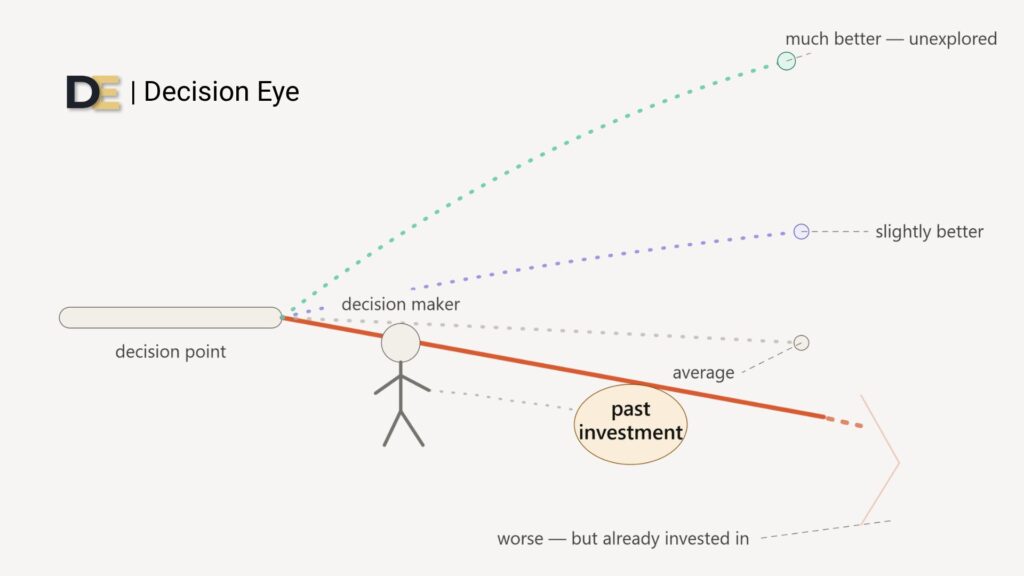
We ate our fish, paid the bill, and left. Afterwards, we went looking for another place. What we’d experienced, in fact, was a textbook example of the sunk cost fallacy.
Fortunately, what I’d spent there was relatively small. But there are projects, situations, companies, and organizations that fall into this same trap — where the amount wasted because of this fallacy can be millions of times what I spent, and it’s a mistake some institutions are still making today.
Throughout my professional life, I’ve had the chance to see different examples of the sunk cost fallacy many times. For instance, continuing to pursue a customer and trying to sell to them even when it’s clear from the very first notes that they’re not going to buy — spending months, sometimes entire fiscal years, and still failing to close the sale.
Or continuing to allocate time and resources to projects that have clearly stopped progressing or are never going to yield the desired results. When asked why, the answer is always the same: “We’ve already spent so much time and money on this — we can’t turn back now.”
If, at some point, the only reason you’re continuing with a decision is that you’ve already spent a lot of money or effort on it, then perhaps it’s time to reconsider that decision.
What is the Sunk Cost Fallacy?
In his international best-seller The Art of Thinking Clearly, Rolf Dobelli explains the sunk cost fallacy as follows: “The sunk cost fallacy is most dangerous when we have invested a lot of time, money, energy, or love in something. This investment becomes a reason to carry on, even if we are dealing with a lost cause” (Dobelli, 2013, p. 18).
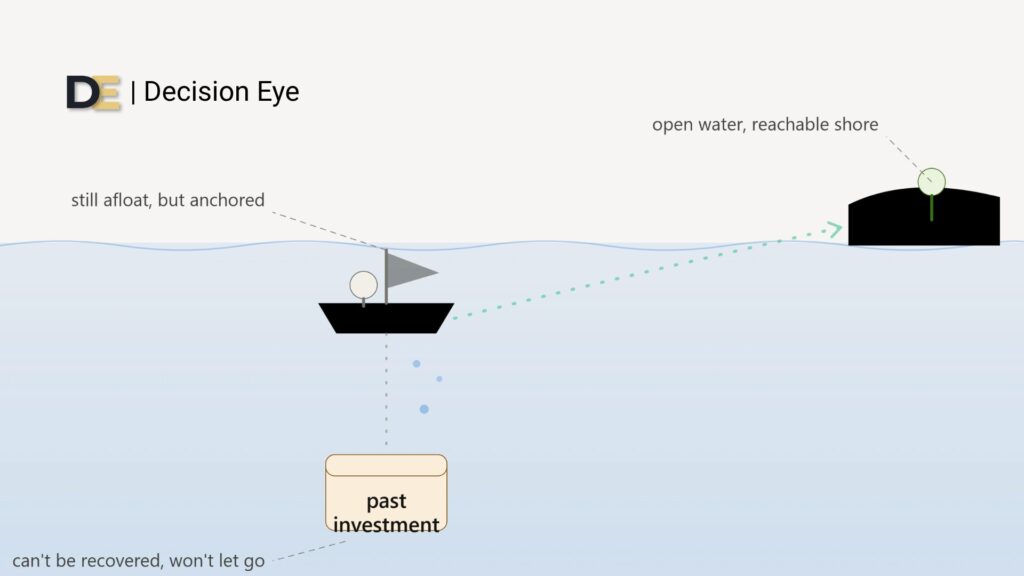
One of the key issues with the sunk cost fallacy is that it keeps us looking backward, at an investment that will never be returned. The rational approach, however, is to look forward — at future costs and benefits.
A War With Huge Costs
As communist forces gained ground in Vietnam through the late 1950s, it raised serious concern in the West, particularly in the United States. Driven by the Cold War-era ‘domino theory’ — the fear that if Vietnam fell to communism, neighboring countries would follow — the US steadily expanded its involvement, from military advisors and financial aid in the 1950s to full combat troops by 1965.
However, this wasn’t a conventional war. The US army was a standard, conventional force with well-known tactics and operational capabilities. The enemy, on the other hand, didn’t have the same resources or firepower — so they relied on a very different approach: guerrilla warfare.
As the war dragged on, America poured millions of dollars, hundreds of thousands of soldiers, and enormous energy into the effort. At the same time, it sparked civil unrest back home, and protests broke out across the country. Tens of thousands of American lives were lost.
Yet US leadership carried on — driven, in part, by the sunk cost fallacy. Their reasoning was simple: “After such losses and costs, if we withdraw now, all of it will have been for nothing.” It wasn’t until 1973 that a peace agreement was signed and US forces began withdrawing — by which point the financial and human cost had multiplied far beyond.
“We are fighting a war with no front lines, since the enemy hides among the people, in the jungles and mountains, and uses covertly border areas of neutral countries. One cannot measure progress by lines on a map.”
General William C. Westmoreland,
the commander of all U.S. military forces in Vietnam
From Everywhere to Nowhere: A Brand’s Fall
When I was in high school, Nokia was a popular brand among students. I still remember my desk mate’s Nokia 3310 and how much he enjoyed playing Snake on it. The 3310 was a sturdy, no-frills model, but some of their other models were sleek, almost like little soap bars. People carried them with pride — I still don’t quite understand how a phone brand could bring someone pride, but that was the spirit of the time. Nokia seemed like one of the greatest companies in the world, and it felt like nothing could change that.
Apple released the iPhone in 2007, marking a complete shift in direction for the mobile phone market. In the years that followed, Apple’s sales soared, and it became one of the world’s most successful companies — while Nokia steadily lost ground. Nokia was big, and it had the resources, but it couldn’t adapt. As a result, its market cap declined significantly.
So what prevented Nokia from changing course and investing in this new technology? Yes, you guessed it — the sunk cost fallacy, once again. Nokia had invested heavily in its existing hardware architecture, and because of that, it couldn’t react quickly enough to the new wave of technology.
“If you don’t cannibalize yourself, someone else will.”
Steve Jobs
The Psychology Behind It
Why do people fall into this trap? Maybe because of low competence — no, not at all. Neither Nokia’s leadership nor the US leadership of that era lacked competence. They were smart, highly educated, and experienced professionals. And yet, it still happened. No degree, education, or job title can protect you from the sunk cost fallacy — unless you’re specifically aware of it. Common reasons include:
- Loss aversion. Losses feel far more painful to accept than equivalent gains feel pleasurable.
- Consistency. I’ve lost count of how many times I’ve heard the word “consistency” throughout my career. Admitting “we made the wrong decision” can feel like a direct blow to the ego.
- Waste perception. The idea of having used resources for nothing is something almost no one can easily stomach.
- Social judgment. It can feel easier to stay on the wrong path than to risk criticism by admitting the truth.
How to Avoid the Sunk Cost Fallacy
Be honest with yourself. I think this is the most important thing to do when you’re facing it. And second — remember, it’s not the end of the world.
“We’ve invested so much…”, “I’ve known her since high school, we’ve been through so much together…”, “We’ve come this far…”, “I’ve been attending this training for two years…” If you recognize a thought pattern similar to this, the sunk cost fallacy may be at play.
If your only reason for carrying on is the investment you’ve already made, you may be a victim of the sunk cost fallacy. Improving your decision-making competence can also help you become more aware of these kinds of traps. You can check out What Makes a Decision Rational vs. Right? to better understand the difference between rational and right decisions. And for sharper reasoning in general, Decide Better: The Power of Bayesian Reasoning offers insight into other cognitive traps.
What to do tomorrow?
Next time you suspect the sunk cost fallacy might be at play, you can try this:
- Ask yourself this question: “Knowing what I know now, would I still make this same decision?”
- Try to forget about past costs — focus only on future costs and benefits instead.
- Talk it through with others and think outside the box, without letting emotion drive the decision. An outside perspective can help you see angles you might be missing.
- Count your reasons for continuing — is it just one, or several?
References
- Dobelli, R. (2013). The art of thinking clearly. Sceptre.
- Isaacson, W. (2011). Steve Jobs. Simon & Schuster.
- General stresses Viet gains. (1967, April 29). Chicago Tribune. http://archives.chicagotribune.com/1967/04/29/page/7/article/general-stresses-viet-gains

Timucin Tasdemir, M.Sc.
Decisions aren’t found. They’re built.
I write about decision-making, cognitive biases, and decision architecture at Decision Eye. Most poor decisions come not from a lack of intelligence, but from a lack of structure.
Disclaimer: The views and opinions expressed in this article are solely my own and do not reflect the official policy or position of any past, present, or future employer or affiliated organisation. This content is intended for informational and educational purposes only and does not constitute professional advice.
Leave a Reply