Even experienced leaders decide by instinct. This map helps you know when to trust it and when to think twice.
I was meeting with my manager years ago. He was a regional leader who had extensive experience.
We were discussing a decision and the next steps for customer engagement.
At one point, he said, “I don’t feel right about this decision.”
I was surprised because I had expected more rational and analytical reasoning.
However, this was one of the many observations about decision-making I made in the business world.
Over a decade, I noticed that senior leaders, vice presidents, directors, managers, and others rely heavily on their instincts to make decisions, even complex ones.
On this site, I have written about sunk cost, confirmation bias, the Ellsberg paradox, inversion, and a handful of other ideas. Each article explains one concept well enough. But something kept bothering me: when you are actually facing a decision, which of these ideas do you reach for, and when?
A pile of concepts is not a method. What was missing was a map.
Gut Feeling
Actually, relying on your instincts is not a bad thing. Your instincts play a vital role in navigation. However, using the same hammer for every job in complex environments like modern business settings may lead you to miss opportunities and overvalue quick solutions. There are many cognitive biases, and the human brain loves shortcuts.

What Science Says About Gut Feeling
There is an extensive debate about gut feeling in the scientific world. In the mid-1980s, psychologist Gary Klein studied fire commanders, expecting them to compare options before acting. As stated in his study, “The major finding was that in less than 12% of the decision points there was no evidence of simultaneous comparisons and relative evaluation of two or more options.” This study was also repeated with different specialists, and similar results were found. The experts were relying on their experience to make their decisions in the field. They recognise a situation as familiar, retrieve a workable action, and test it mentally. They don’t hunt for the best option, only the first one that works.
However, they had worked in their fields to develop this experience, which is helpful for pattern recognition. So, how could someone who doesn’t have experience like that just rely on their gut feeling to make a decision? What if there is a pattern that experts haven’t experienced before?
“If, after some reflection, you feel that your earlier decision was wrong, let nothing stop you from changing it.”
Umar ibn al-Khattab (r.a.)
My questions are simple: is it worth trusting gut feeling in all conditions? Does Gut Feeling help us to make the right decision? If you want to learn more about what is the right decision then please check out my article: What makes a decision rational vs right?
When Can You Trust Your Instincts?
Kahneman and Klein think differently. In their article, they stated that “The intuitive judgments of some professionals are impressively skilled, while the judgments of other professionals are remarkably flawed.” They asked a question similar to mine: “Under what conditions are the intuitions of professionals worthy of trust?” Actually, this is a worthy question if we look at history. Even great leaders who were experts in management made mistakes despite their achievements. Gut feelings deserve trust only in stable, predictable settings with fast, clear feedback, such as chess, firefighting, and nursing. Relying on gut feeling fails in noisy, low-feedback domains like stock picking and long-range forecasting. Also, my observations about different fields are similar. Relying heavily on gut feeling could lead experts into confirmation bias, liking bias, and other cognitive biases.
Non-Linear World
When I was studying in the Mechanical Vibrations & Acoustics program at the Faculty of Engineering, one of my important tasks was dealing with higher-order differential equations. The concept of these equations fascinated me because they had similarities to life. These equations described non-linear shapes, and they required special attention.
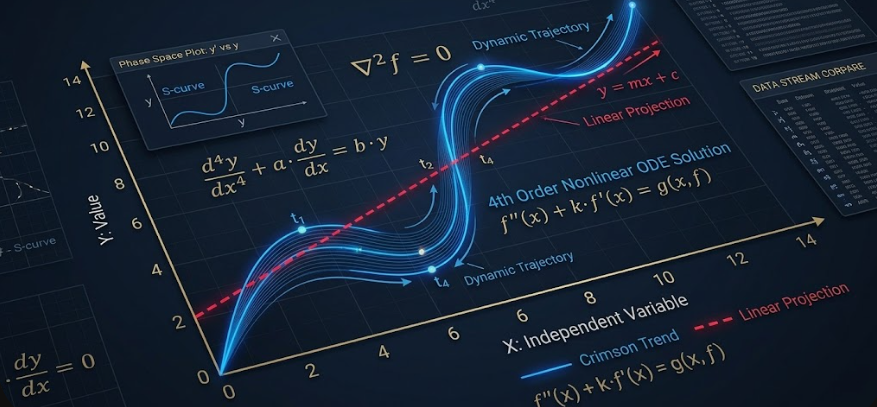
I have always thought that life has a similar pattern. As human beings, our brains tend to think linearly or expect linear results, but in reality, things can go in different directions, like a non-linear equation. This brings some challenges, such as adaptation and flexibility. Therefore, I started to think about a system that is flexible enough to adapt to different situations and robust enough to generate tangible results.
“Don’t walk the beaten path, don’t fear innovation, and carve your own trail.”
Alexander Graham Bell
The Decision Building System
How the Decision-Making Framework Works
Based on my experience, research, and observations, decision-making is clearer when it serves a purpose. Therefore, the first step is determining the goal. Imagine you left your home to go to a holiday destination. You would like to get there on time and without any issues. What is the goal? The goal is to complete the journey on time, within budget, and without problems.
Layer 1: The Decision Building Cycle
The Decision Building System is a practical way to build better decisions, one case at a time. Instead of treating every choice with the same habits, it gives you a map made of two layers. The first is the Decision Building Cycle, five phases that take a decision from start to finish: Goal, Frame, Weigh, Decide, and Observe.
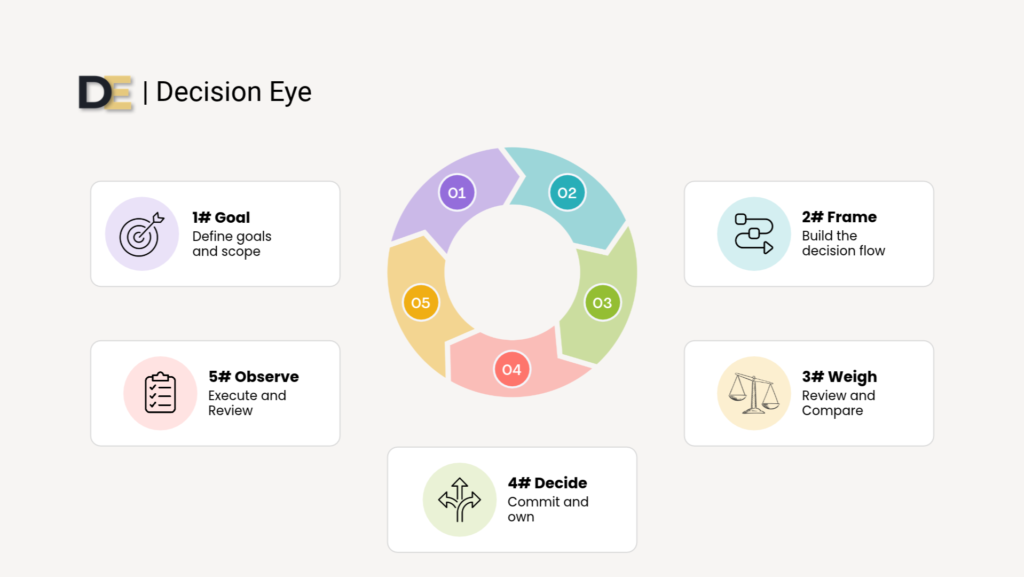
Goal. What outcome am I actually after, and how will I know I got it? Many bad decisions start with an unclear target.
Frame. What is the real question? What am I leaving out of the picture? The way a problem is framed quietly limits every option you will consider. (Ellsberg Paradox: The Difference Between Risk and Uncertainty shows how framing changes what feels safe.)
Weigh. How do the options compare against the goal? This is where tools earn their place: Eisenhower Matrix and Pareto: Beat Mental Noise for prioritizing, How to Use a Decision Tree for Better Decisions for branching outcomes, Forced Ranking Method: How to Make Better Group Decisions for group choices, and Inversion Thinking: How to Identify Risks Before They Happen for finding what could go wrong before it does.
Decide. Commit, and own the choice. Sometimes the most rational option and the right one are not the same, which is the subject of What Makes a Decision Rational vs. Right?
Observe. What actually happened, compared with what I expected? This is the phase most people skip, and it is the one that feeds the next Goal. That is why it is a cycle and not a line.
Layer 2: The Debiasing Library
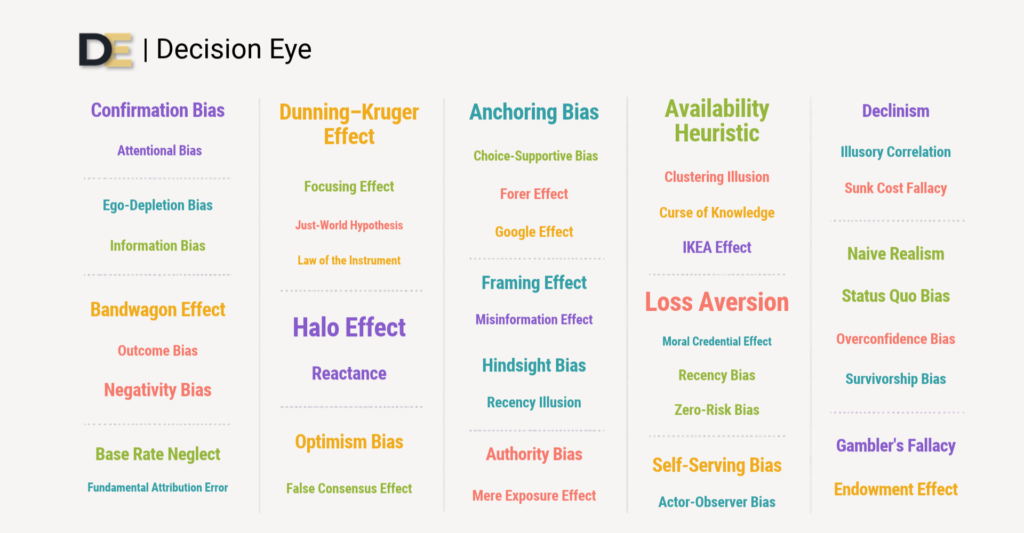
The second layer is the Debiasing Library, a set of methods for countering the cognitive biases and paradoxes that quietly distort our thinking, each tagged to the phase where it strikes hardest. Liking bias, for instance, tends to bend the Weigh phase, while sunk cost grips us in the Decide phase. This is because every decision is different, and each one involves a different set of biases.
How to use it
Take a project that is running behind schedule while you keep investing in it. In Goal, restate what the project was meant to achieve. Next, in Frame, ask whether “finish this project” is even the right question, or whether the real question is “solve the problem the project was for.” In Weigh, compare continuing, changing course, and stopping. When you reach Decide, pull the sunk cost card: what you have already spent is gone either way. Then in Observe, check the results on a set date and carry what you have learned into the next decision.
Same structure, different methods, a different decision each time.
References
- Klein, G. A., Calderwood, R., & Clinton-Cirocco, A. (1986). Rapid decision making on the fire ground. Proceedings of the Human Factors Society 30th Annual Meeting, 1, 576–580.
- Kahneman, D., & Klein, G. (2009). Conditions for intuitive expertise: A failure to disagree. American Psychologist, 64(6), 515–526. https://doi.org/10.1037/a0016755

Timucin Tasdemir, M.Sc.
Decisions aren’t found. They’re built.
I write about decision-making, cognitive biases, and decision architecture at Decision Eye. Most poor decisions come not from a lack of intelligence, but from a lack of structure.
Disclaimer: The views and opinions expressed in this article are solely my own and do not reflect the official policy or position of any past, present, or future employer or affiliated organisation. This content is intended for informational and educational purposes only and does not constitute professional advice.
Leave a Reply