When uncertainty clouds your path, a decision tree could maps every possible outcome
The last thing I remember before losing consciousness was a glimpse of blue sky. I had just finished a full day of engineering training with a client. My colleague called to pick me up — I stepped one lane over, and a car hit me. Fifteen minutes later I woke up surrounded by strangers.
You could know what you choose but you cannot know what will happen. Navigating uncertainties is a key for better decisions. In this article, I will explain to you the concept of uncertainty, decision tree and finally how to build your own step by step guide.
A Small Decision, A Life-Changing Outcome
I started my career as an application engineer specializing in selling engineering software products to business customers across various industries. One of my customers worked in the power and utilities industry, manufacturing high-voltage equipment. They requested finite element analysis training to apply to a research and development project, so we organized a session for them.
On the day of the training, teams were heading to different parts of the city. I had a few options for getting to the customer and chose to travel with a second team whose route passed near the site.
After a long day of research and development discussions, I finished the training and returned to the pickup point. My colleague called and asked me to step one lane over so he could collect me. As I crossed, a car struck me. The only thing I remember is being thrown into the air, a glimpse of blue sky, and then complete darkness. I lost consciousness for fifteen to twenty minutes, and when I came to, I found myself surrounded by a crowd of people. An ambulance arrived shortly after, and bystanders helped the paramedics carry me away.
At the hospital, an unusually large number of doctors were waiting for me. As I later learned, the driver who had hit me was a physician on staff there. He had stopped immediately after the collision, administered first aid, and coordinated both the ambulance and my reception at the hospital. After the accident, I took a few weeks off and struggled to walk for a time, but eventually made a full recovery.
One of my questions was: If I chose another path to go to the customer, would the same thing happen? It is a clear story of how our lives depend on uncertainties. Sometimes even a small decision could lead you to a catastrophic event. If you would like to learn more about how decisions contain uncertainity based on a real world story you can check out my article: The High Cost of an EV Decision.
What is a Decision Tree?
It is a graphical description of a decision with different alternatives including uncertainty as well as possible outcomes. In Smart Choices book; Hammond, Keeney, and Raiffa described it as “A decision tree illustrates the relationships between choices and uncertainties while providing a visual representation of the essence of the decision.” A decision tree simply illustrates the relationship between alternatives, risks, and outcomes.
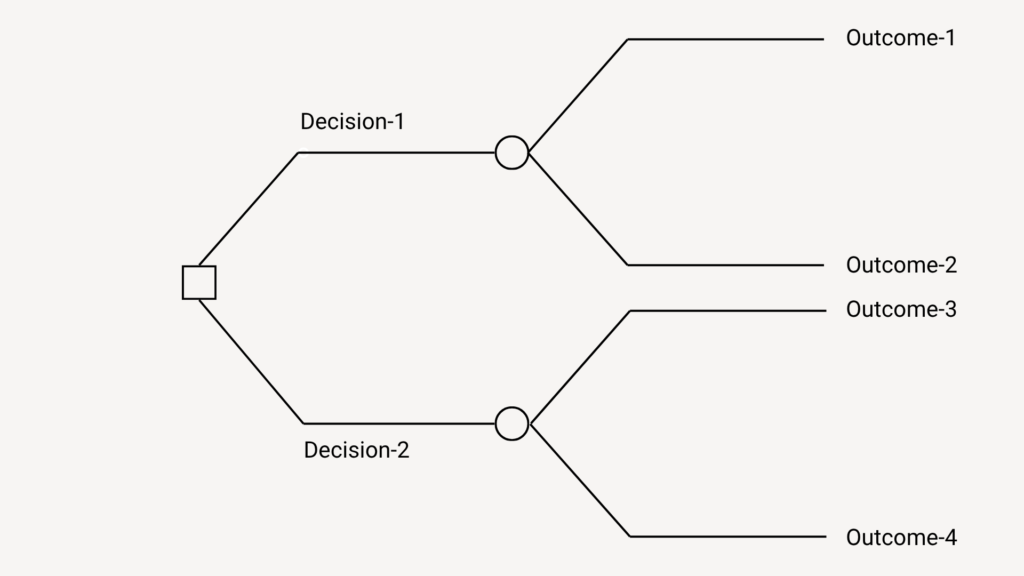
One of the misconceptions regarding decisions is forgetting time factor and considering one time activity. Actually, in reality, it is quite the opposite. A decision can evolve through time and when a decision is made, then an uncertain outcome could be observed, then another might need to be made, then another uncertain outcome could occur, and so on. A decision tree is a useful way to illustrate these details in an intuitive format.
Uncertainty and Probability
In An Introduction to Decision Theory book, Martin Peterson explained “The classical interpretation, advocated by Laplace, Pascal, Bernoulli, and Leibniz, holds the probability of an event to be a fraction of the total number of possible ways in which the event can occur.”
On the other hand, in the Reasoning about Uncertainty book, Joseph Y. Halpern gave a different explanation than probability for uncertainty as “Uncertainty is a fundamental and unavoidable feature of reality. It is a fundamental and unavoidable feature of daily life; in order to deal with it intelligently, we need to be able to represent it and reason about it.”
“As far as the laws of mathematics refer to reality, they are not certain; and as far as they are certain, they do not refer to reality.”
Albert Einstein
There is a long lasting debate for these terms. Probability is a term used for both random variation in the world and our uncertainty about things. Uncertainty is a wider concept however probability is the language we use to speak about uncertainty when we have enough information to express it.
Let me explain these concepts via a Decision Tree in a concrete manner.
Use Case: Employee Gathering
Stephanie is working as Executive Assistant in a global software company. She has a task to organize an employee gathering for summer. Stephanie’s budget is £12000 and the number of employees to invite is 100. Stephanie considers two different options. The first one is Picnic at National Park and the second one is a one day long event at town hall. The date is 24 July and South London could be rainy on that day. After little search Stephanie noticed that there is a 40% probability for the rain in the region on that day. Let’s design a decision tree.
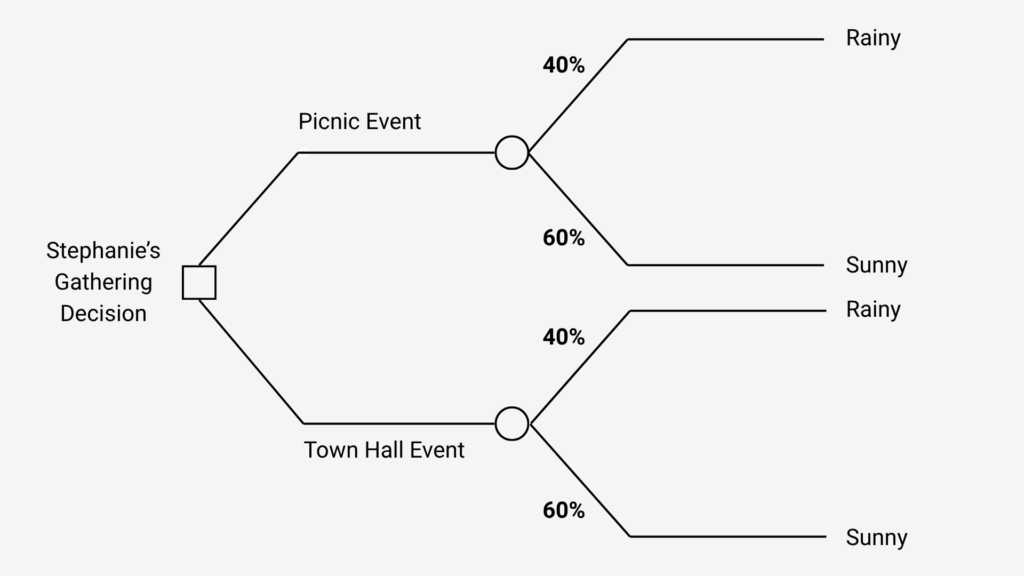
In the decision tree Stephanie has two choices and each choice leads to two different outcomes: Rainy day or Sunny day. According to the weather forecast there is a 40% chance for rain. This is probability but Stephanie is not sure although there is 40% chance for rain or 60% chance for sun it will happen. This is uncertainty as she is uncertain about them.
Stephanie’s Town Hall Event cost £10000 but Picnic is £9500. In terms of satisfaction, the picnic outcome will be great but Town Hall one probably good. One of the other parameters for Stephanie is that families should meet each other at the event. Picnic seems a better alternative than Town Hall for this parameter. Let’s see these details in table view:
| Alternative | Weather | Outcome | Family Engagement | Cost |
| Picnic Event | Rainy | Low | Low | £9500 |
| Picnic Event | Sunny | High | High | £9500 |
| Town Hall | Rainy | Good | Medium | £10000 |
| Town Hall | Sunny | Good | High | £10000 |
In table view these details give us a structure but when we put them into a Decision Tree then it will make sense in terms of uncertainty.
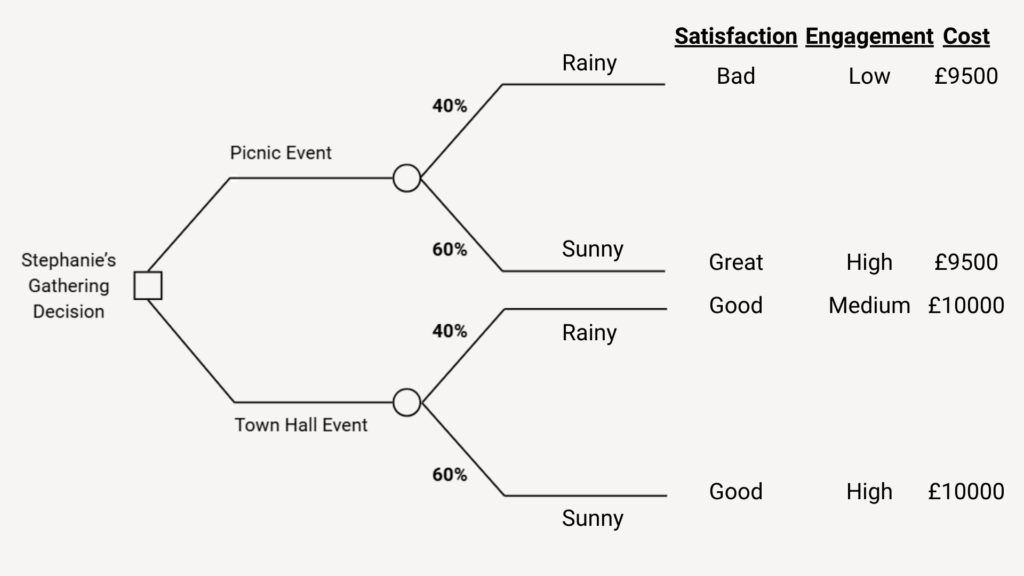
After building the decision tree, Stephanie shares it with his colleagues to make a collective decision. Such a decision tree is a good illustration of alternatives with possible outcomes and could streamline collaboration. After reviews and careful consideration, Stephanie chose the picnic alternative.
The Principle of Maximizing Expected Utility
Stephanie made her decision after building a diligent decision tree and a couple of meetings with colleagues. This is a usual way in today’s business world to make a decision except for the decision tree. However, let’s think Stephanie would like to compare the overall expected value of each alternative. In that case, she needs to use the principle of maximizing expected utility. This is the most commonly applied decision rule for making decisions under risk. This principle explains that the total value of an act equals the sum of the values of its possible outcomes weighted by the probability.
Stephanie knows the probabilities from the weather forecast but what about utility? Well, she decides to give numeric values for different experiences between 0.1 and 1. If it is greater than 1 but if it is bad than 0. Let’s put these in the equation:
According to the formula and assumptions to make calculations, Expected Utility of Picnic calculated as 0,64.
Now Stephanie has two expected utilities of alternatives, if we look from a utility perspective choosing Picnic seems more rational than Town Hall.
Always uncertain?
Not every decision involves risk — some carry a degree of certainty and call for different thinking altogether. For straightforward choices, the Forced Ranking Method offers a practical approach, as explored in a previous article. Benjamin Franklin’s method is another option worth considering; that article covers how he guided his London friends toward more thoughtful decisions. For those struggling with priorities, the Importance & Difficulty Matrix article addresses one of the more persistent challenges in today’s business world.
What to do tomorrow
Next time you face a decision with uncertain outcomes, you can try this:
- Write down your two or three main alternatives.
- For each alternative, list the possible outcomes — what could go right, what could go wrong.
- If you have any probability data (forecasts, past experience, research), assign rough percentages.
- Calculate the expected utility for each alternative and compare.
You don’t need a perfect model. or know everything. Even a rough decision tree on paper will force clarity that most people never reach.
References
- Hammond, J. S., Keeney, R. L., & Raiffa, H. (1999). Smart choices: A practical guide to making better decisions. Harvard Business School Press.
- Peterson, M. (2009). An introduction to decision theory. Cambridge University Press.
- Halpern, J. Y. (2003).Reasoning about uncertainty. MIT Press.

Timucin Tasdemir, M.Sc.
Decisions aren’t found. They’re built.
I write about decision-making, cognitive biases, and decision architecture at Decision Eye. Most poor decisions come not from a lack of intelligence, but from a lack of structure.
Disclaimer: The views and opinions expressed in this article are solely my own and do not reflect the official policy or position of any past, present, or future employer or affiliated organisation. This content is intended for informational and educational purposes only and does not constitute professional advice.
Leave a Reply