You think you have the evidence. You think you are right. But confirmation bias may already have you — and you would never know.
As I walked toward the conference room, I felt prepared. I had studied the agenda and completed the research based on the information provided to me. An executive team from the client was waiting for us. Together with my dealer, we began reviewing the documents they sent.
I immediately noticed that the document was a thorough feature comparison with a competitor’s product. As I learned the details, the situation became clear. The client had recently hired a new engineer who knew the competitor’s solution well and preferred it over our product. He wanted to see the competitor’s features in our product, and when he found they were absent, he flagged it as a major issue.
Clear Signal
This engineer had challenged my partner and put him in a difficult position. He had already secured approval from his own managers and had made significant progress in convincing them that our solutions were inadequate.
This was a clear signal: the client had already made their decision.
When I called my sales colleague to report the situation, our conversation revealed that he, too, was a victim of confirmation bias. He tried to brush the matter aside, refusing to accept that such an outcome was possible. He had also fallen into another trap — the Sunk Cost Fallacy. Having invested so much time in this client, walking away felt impossible.
He informed me that he had spoken with the client’s executives, received their apologies, and was told they were very sorry about the incident. They had told him, “Please do not misunderstand us; we want to solve the problems we encountered.” Based on this, my sales colleague was trying to organize another joint meeting.
I warned him. I told him that we had nothing left to achieve with this client, that we should walk away, and that they had already made up their minds.
What is Confirmation Bias?
Confirmation bias is a powerful force. In the professional world, few biases cause more trouble for professionals.

It generally operates like this: a person formulates a simple theory about an event, finds one or two pieces of evidence that seem to support it, and, by trusting this limited data, confirms the theory. We see this daily in business articles, magazines, and social media posts.
According to research on belief formation, confirmation bias is the tendency of agents to seek out or overweight evidence that aligns with their beliefs while avoiding or underweighting evidence that contradicts them (Kaanders et al., 2022).
A Common Pitfall in Modern Workplace
“Confirmation bias is probably the single biggest problem in business because even the most sophisticated…”
Daniel Kahneman
In his book, The art of thinking clearly Rolf Dobelli highlights that “The confirmation bias is the mother of all misconceptions.” In business, this error occurs most frequently during change and project management. The leaders track a few specific parameters, and when these parameters yield positive results, they believe the entire process is succeeding.
In Recruitment
Another common example occurs when managers recruit new talent. They often select candidates who match their own thinking and belief systems. By choosing candidates who view events exactly as they do, executives surround themselves with a small echo chamber. Because these hires rarely challenge their managers or point out mistakes, the leadership assumes their metrics and strategies are correct, even when they are failing. Consequently, projects are lost, change is sabotaged, and programs collapse.
On the other hand, according to research, diverse groups tend to outperform. In their research, Groups of diverse problem solvers can outperform groups of high-ability problem solvers, Hong & Page highlight that diversity should be encouraged.
In Politics
Confirmation bias is also common in politics. Government leaders often surround themselves with like-minded individuals who validate their choices. These advisors rarely debate the flaws or negative consequences of policies. This trap can cause governments and states to suffer immense losses. If you want to be successful as a leader, you must welcome people with diverse perspectives into their inner circle.
In the research, Better decisions through diversity. examined the why behind diversity’s success. The authors found that when a group is cognitively or socially diverse, the members actually prepare better and anticipate alternative viewpoints before the meeting even starts. In homogeneous groups, people assume everyone thinks alike, leading to lazy thinking, lack of preparation, and susceptibility to confirmation bias. (Phillips et al., 2009).
In Startups
Entrepreneurs are optimistic based on their nature about their business. Confirmation Bias significantly impacts the startup world and leads to failure quite often. One of the common pitfalls is looking at the metrics that tell a story about the success but actually not really matters in terms of outcome. In his famous book, The Lean Startup, Eric Ries explains this vividly: A startup’s job is to (1) rigorously measure where it is right now, confronting the hard truths that assessment reveals, and then (2) devise experiments to learn how to the real numbers closer to the ideal reflected in the business plan.
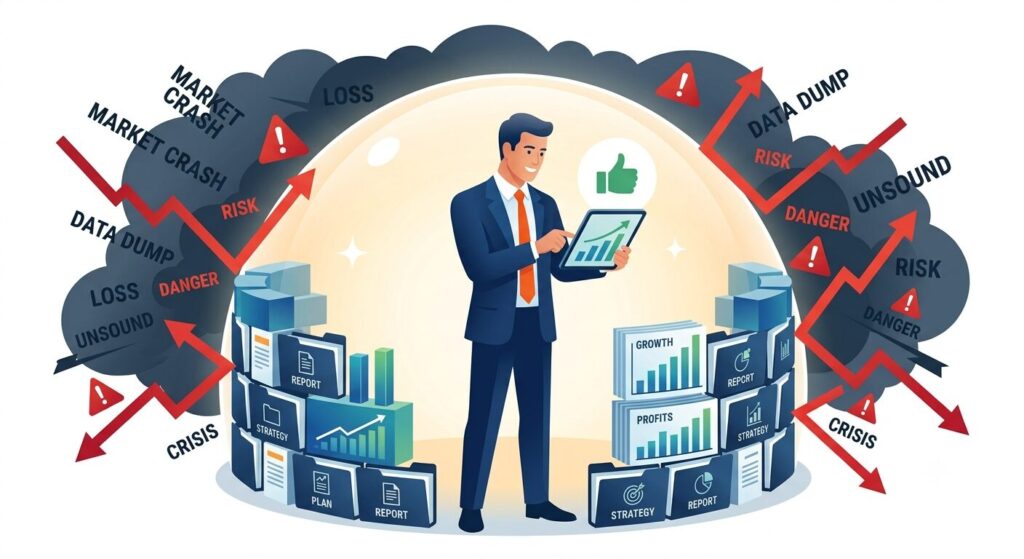
In Everyday Life
This bias does not only affect leaders; it impacts ordinary people as well. Many individuals deliberately build friendship groups composed entirely of people who share their beliefs and behaviors. If they have friends who think differently, they gradually distance themselves or cut ties entirely. As a result, their social circle reinforces their views and shields them from the truth, allowing mistakes to persist for years.
The Mechanism of the Bias
In any situation, the human brain is highly adept at finding evidence to support what it wants to believe. If we believe something is bad, our minds find reasons to confirm it. If we love something, we find data to justify our affection. In both cases, we look at the evidence, declare ourselves right, and fall into the trap.
How to avoid?
To effectively combat confirmation bias, you must move beyond passive awareness and implement active, structural habits that disrupt the brain’s natural tendency to seek validation. One practical tool is the Forced Ranking Method — a structured approach that removes personal bias from group decisions by quantifying preferences rather than debating them.
Start by actively seeking out information that challenges your existing beliefs rather than looking for data that supports them; this shifts your focus from merely confirming a hypothesis to rigorously testing its validity. Additionally, practicing the “pre-mortem” technique—where you imagine a decision has already failed and work backward to understand why—can reveal hidden flaws in your thinking.
What to do tomorrow?
Tomorrow, before your next important meeting or decision, try this: write down three reasons why you might be wrong. Not why you are right — why you might be wrong. Then find one person who disagrees with your current position and genuinely listen to their argument.
This single habit, practised consistently, is one of the most effective antidotes to confirmation bias.
In group settings, consider assigning someone as Devil’s Advocate — ideally someone who is not afraid to challenge assumptions and call out what others might be reluctant to say.
Reference
- Kaanders, P., Sepulveda, P., Folke, T., Ortoleva, P., & De Martino, B. (2022). Humans actively sample evidence to support prior beliefs. eLife, 11, Article e71768. https://doi.org/10.7554/eLife.71768
- Dobelli, R. (2013). The Art of Thinking Clearly. Sceptre.
- Hong, L., & Page, S. E. (2004). Groups of diverse problem solvers can outperform groups of high-ability problem solvers. Proceedings of the National Academy of Sciences, 101(46), 16385–16389. https://doi.org/10.1073/pnas.0403723101
- Phillips, K. W., Liljenquist, K. A., & Neale, M. A. (2009, October 1). Better decisions through diversity. Kellogg Insight. https://insight.kellogg.northwestern.edu/article/better_decisions_through_diversity
- Ries, E. (2011). The Lean Startup: How today’s entrepreneurs use continuous innovation to create radically successful businesses. Crown Business.

Timucin Tasdemir, M.Sc.
Decisions aren’t found. They’re built.
I write about decision-making, cognitive biases, and decision architecture at Decision Eye. Most poor decisions come not from a lack of intelligence, but from a lack of structure.
Disclaimer: The views and opinions expressed in this article are solely my own and do not reflect the official policy or position of any past, present, or future employer or affiliated organisation. This content is intended for informational and educational purposes only and does not constitute professional advice.
Leave a Reply