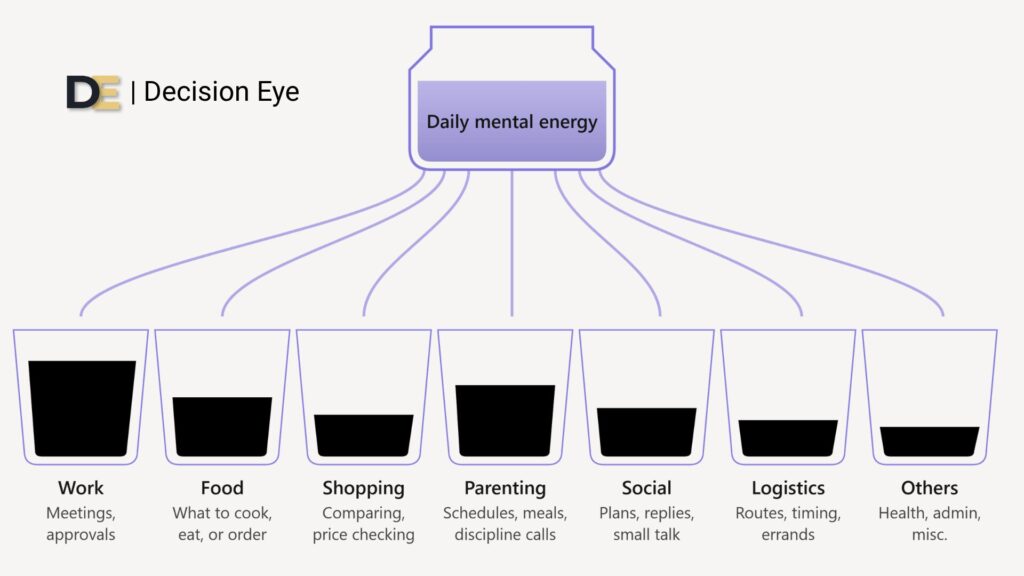
Decision fatigue could quietly drain our limited mental energy across work, food, shopping, and family until even small choices start to feel exhausting.
Our brains have a capacity to process information much like our computers, and when we exceed that limit, things can start to seem more complex.
After a week-long business trip, I finally returned home. My journey started at 06:30 on Monday morning and ended at 19:00 on Friday. With approximately 20 customer meetings and three different partners, the simplest term to describe the trip was ‘rush.’ I sat in front of the TV and started to play with my son. Then I realized I was struggling to be receptive. The reason wasn’t the trip, but Decision Fatigue.
There Is a Limit
I remember that at the start of the trip, I was fresh and ready to take on the week. The first day started with a customer meeting, and a group of professionals was waiting for me to deliver the sales pitch. I presented to them and answered their manufacturing-process-related questions. These questions were highly sophisticated and required domain knowledge, but some also didn’t have direct answers. In those cases, I shared the answer honestly but also proposed a possible workaround within the solutions I offered. These were decisions, followed by more decisions. Sometimes, these meetings were followed by strategic partnership meetings with local institutes and partner ecosystems.
After all of this, by the end of the week, I remember the feeling of emptiness and the cognitive struggle to make choices, even for small things like choosing a cookie for my latte, buying a toy for my children, or replying to an ordinary email.
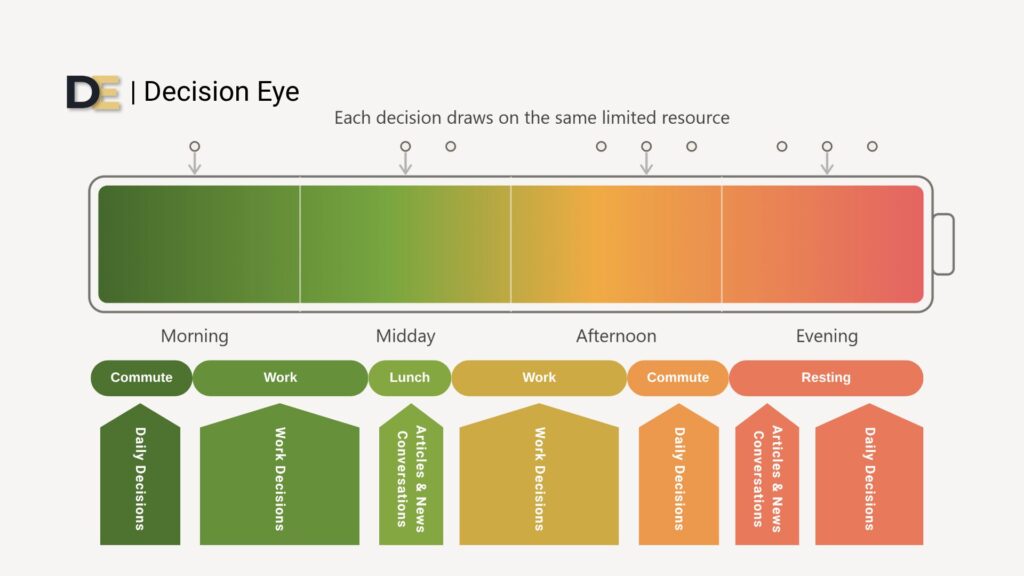
On the other hand, I was overloading my cognitive capacity. Waiting in airports, lounges, stations, and vehicles, I checked the news, read articles, and watched TV commentary on issue after issue. I read columns from famous authors — even foreign ones, like Paul Krugman. I absorbed information about things I couldn’t control or solve. Looking back, this flood of information only clouded my view and drained my daily cognitive capacity. That doesn’t mean reading the news is always bad — but spending too much time on it, I’m not sure how that helps you.
“You’ll see I wear only gray or blue suits. I’m trying to pare down decisions. I don’t want to make decisions about what I’m eating or wearing. Because I have too many other decisions to make.”
Barrack Obama
Our brains have a limit on what they can compute. In a day, there are certain ranges for how much food a human can consume, based on the situation. In one article in the British Food Journal, Olsen, Meyerhoff, Mørkbak, and Bonnichsen note that making choices requires cognitive effort, and since cognitive capacity is limited, making choices may lead to decision fatigue.
Same for Everyone, or Just Some?
If you wonder that you have ever experienced decision fatigue in your life then let’s make a quick test to understand. Please answer these questions honestly:
- After a day full of choices at work, do you find it harder to decide things at home? (Y/N)
- Do small decisions (what to eat, what to wear) feel like solving calculus problems on some days than others? (Y/N)
- Have you noticed impulsive purchases or quick decisions happening more often when you’re tired or stressed? (Y/N)
- Have you procrastinated on the small decision that requires little effort after a rush period? (Y/N)
- Have you found yourself struggling to answer the simple questions from your children at some evenings? (Y/N)
- Have you delegated decisions to someone else (partner, assistant, app) specifically because you felt too tired to decide?(Y/N)
- Have you noticed feeling more irritable or anxious after a day filled with many small decisions? (Y/N)
- Have you noticed your patience with colleagues, friends, family members or customers decline as the day progresses? (Y/N)
- Have you ever abandoned a shopping cart (online or in-store) because comparing options felt overwhelming? (Y/N)
- Do you eat the same meals repeatedly to avoid deciding what to cook? (Y/N)
I could add more questions, but I think you get the idea. If you answered yes to even a few, you may be experiencing decision fatigue. These questions are only guidelines, though — for a real assessment, see a certified therapist or healthcare professional. As Pignatiello, Martin, and Hickman note in Decision Fatigue: A Conceptual Analysis, the process of making choices was associated with increased procrastination tendencies. Some individuals experiencing decision fatigue even reach a point where they simply choose not to act.
There Are Consequences
It is estimated that an American adult makes 35,000 decisions a day (Decision Fatigue: A Conceptual Analysis; Pignatiello, Martin, and Hickman Jr). This number is composed of both personal and work related decisions. Also, according to studies, students experiencing decision fatigue spent more time completing tests than students who were not experiencing decision fatigue. Additionally, there are some fields where decision fatigue could lead to severe consequences. In the article An Integrative Review on Unveiling the Causes and Effects of Decision Fatigue to Develop a Multi-Domain Conceptual Framework, Choudhury and Saravanan note that “According to NASA, 80% of aviation accidents occur due to human errors in the decision-making process during uncertain circumstances.”
Some decisions require more mental effort than others, when decisions include uncertainty and not obvious alternatives, the decision maker needs to put more diligence on the process like drawing a decision tree. You can find my article here How to Use a Decision Tree for Better Decisions. On the other hand some decisions are relatively easier than others, for example choosing a restaurant with colleagues. I explain a similar case in this article How to Make Decisions with the Forced Ranking Approach: A Lesson from Berlin.
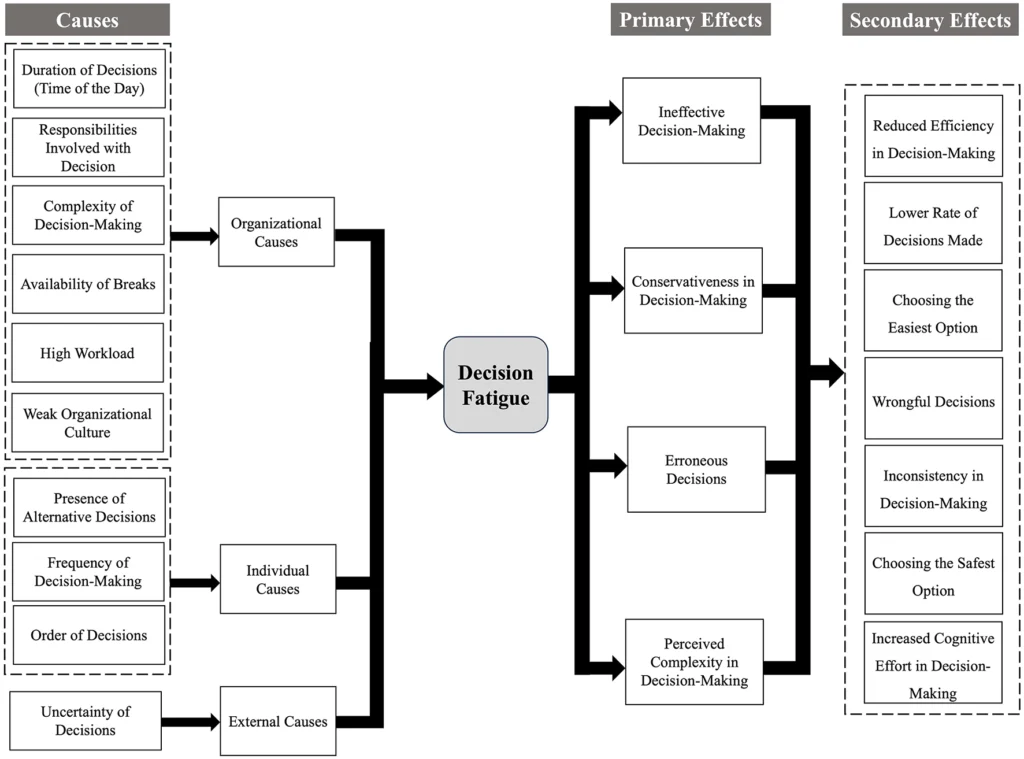
According to work at An integrative review on unveiling the causes and effects of decision fatigue to develop a multi-domain conceptual framework, Choudhury and Saravanan outlines these primary effects as result of decision fatigue which a study distilled from 1020 articles on decision fatigue:
- Ineffective Decision Making
- Conservativeness in Decision-making
- Erroneous Decisions.
- Perceived Complexity in Decision-making.
A Familiar Scenario: Mark’s Fatigue
Mark works as an analyst at a consultancy firm. His job requires multistakeholder engagement, and he’s also a father. He spends his out-of-office time co-parenting his daughter. Mark and his ex-wife divorced two years ago, and he now makes some decisions about their child alone — adding to his cognitive load.
On top of this, his boss shows narcissistic tendencies at work: hiding information from the team, absorbing credit, moving goalposts, backbiting, and limiting Mark’s visibility to senior executives and the wider organization. Mark feels stressed, and from time to time he experiences nitpicking from his boss. Yet he needs this job to support his daughter and pay alimony.
The situation has piled more weight onto Mark’s shoulders. He now needs to act carefully and make decisions wisely. Still, he finds himself struggling even with small tasks at home — something like a mental shutdown.
Mark opens up to Jacob, one of his closest friends. Jacob has known for a while that Mark’s situation isn’t good — especially the work-related issues, which keep adding complexity. Still, he’d like to suggest a solution.
“You need to take some time off for yourself first.” Jacob speaks calmly then adds “You can not solve everything by yourself. Sometimes going away from the situation can give another perspective.”
“I don’t know how to solve all of these.” Mark said and his voice was tired.
“First, you need to change your mindset and perspective. Don’t be a victim, and don’t play the blame game.” Jacob’s voice was strong.
“Is what she’s doing normal?” Mark objected.
“No, not at all. She is insecure, probably you have a narcissistic boss but that shows something, the problem is not you.” Jacob softened his voice.
“I don’t know, Jacob. Sometimes when I get home, I feel exhausted.” Mark sounds desperate.
“Let me tell you. I recently read a book by an Islamic scholar and poet known as Rumi. Some of his words blew me away.” Jacob was excited, then added:
“If something happens the way you want, look for one goodness; but if something happens in a way you don’t want, look for a thousand goodnesses.”
Jalāl ad-Dīn Muhammad Rumi
“You’re experiencing decision fatigue. First, step away — that alone can help. Then shift your mindset and try to reduce the number of decisions. After that, you can think about a solution: changing jobs, reporting the issue to the company, or something else.” Jacob’s intention is good. After this speech, Mark decides to take a break, rethinks his mindset, and reduces his decisions using some efficiency methods.
The Cure
Every individual is different, and what works for one person doesn’t necessarily work for another. Still, some things hold true for all of us. Increasing your competency in decision-making would be a good step toward eliminating decision fatigue. If you’d like to learn more about managing your tasks efficiently, check out my article The Psychology of Efficiency: How Two Methods Eliminate Mental Noise.
On the other hand, sometimes you’ll find yourself struggling with decisions. Benjamin Franklin’s approach can help — read more in Decisive Clarity: Insights from Benjamin Franklin’s Decision Logic.
On top of this, having a growth mindset is important. Even though situations seem difficult, we should carry on and learn from our mistakes. Who knows — maybe, as Rumi said, some doors open for us, and these could be better than expected.
What to do tomorrow?
Next time when you experience decision fatigue, you can try this:
- Take a break. This could mean walking outdoors or having fun with friends.
- Try to reduce the number of decisions you make. Efficiency methods can help.
- Reserve some spare time at the end of the day and stay away from screens.
- Establish a growth mindset. There are things we can’t change, but also things we can.
Making mistakes is fine if you learn from them. Otherwise, you may waste your resources by repeating the same mistake again and again.
References
- Lewis, M. (2012, October). Obama’s way. Vanity Fair. https://www.vanityfair.com/news/2012/10/michael-lewis-profile-barack-obama
- Olsen, S. B., Meyerhoff, J., Mørkbak, M. R., & Bonnichsen, O. (2017). The influence of time of day on decision fatigue in online food choice experiments. British Food Journal, 119(3), 497–510.
- Pignatiello, G. A., Martin, R. J., & Hickman, R. L., Jr. (2020). Decision fatigue: A conceptual analysis. Journal of Health Psychology, 25(1), 123–135.
- Choudhury NA and Saravanan P (2026) An integrative review on unveiling the causes and effects of decision fatigue to develop a multi-domain conceptual framework. Front. Cognit. 4:1719312. doi: 10.3389/fcogn.2025.1719312
- U.S. Bureau of Labor Statistics. (2025). American Time Use Survey — 2024 results [News release]. U.S. Department of Labor. https://www.bls.gov/news.release/atus.htm

Timucin Tasdemir, M.Sc.
Decisions aren’t found. They’re built.
I write about decision-making, cognitive biases, and decision architecture at Decision Eye. Most poor decisions come not from a lack of intelligence, but from a lack of structure.
Disclaimer: The views and opinions expressed in this article are solely my own and do not reflect the official policy or position of any past, present, or future employer or affiliated organisation. This content is intended for informational and educational purposes only and does not constitute professional advice.
Leave a Reply