How a Harvard thought experiment about colored balls predicted the way a government — and the man who exposed it — would gamble with the truth.
Imagine two urns. The first holds 50 red balls and 50 black balls — you know the odds exactly. The second also holds 100 balls, red and black, but in an unknown ratio. Draw a ball and guess its colour correctly, and you win $100.
Which urn would you bet on?
Most people pick the first urn, even though the odds of winning are identical either way. Mathematically, there’s no reason to prefer one over the other. Psychologically, there’s every reason: we don’t just fear losing, we fear not knowing the odds at all. That gap is the Ellsberg Paradox — proof that people treat risk (odds you know) and uncertainty (odds you don’t) as two entirely different things, even when the math says they shouldn’t, violating the expected utility principle economists had relied on to predict rational choices.
| Urn | Total Balls | Red Balls | Black Balls | Odds |
| Urn 1 (Risk) | 100 | 50 | 50 | 50/50 |
| Urn 2 (Uncertainty) | 100 | Unknown mix | Unknown mix | Unknown |
The man who discovered it went on to live out the paradox with far higher stakes than a coloured ball.
A Ph.D. and a War
Daniel Ellsberg earned his Ph.D. in economics from Harvard in 1962. His thesis, Risk, Ambiguity, and Decision, described the urn problem above and became one of the most frequently cited papers in decision theory. He then went to work for the RAND Corporation and the Pentagon, eventually spending time in Vietnam assessing the war firsthand.
What he found convinced him the war was unwinnable — and that officials in Washington already knew it. Continuing to fight, they’d concluded internally, would only raise the cost in lives and money. They chose to fight anyway, and to keep telling the public otherwise.
Ellsberg returned to the US and made a decision that would cost him his career, his marriage, and very nearly his freedom: he leaked what became known as the Pentagon Papers, 47 volumes and roughly 7,000 pages laying out the government’s own strategies, decisions, and internal assessments of the war (Pentagon Papers). Henry Kissinger, then serving as National Security Advisor, branded him “the most dangerous man in America.”
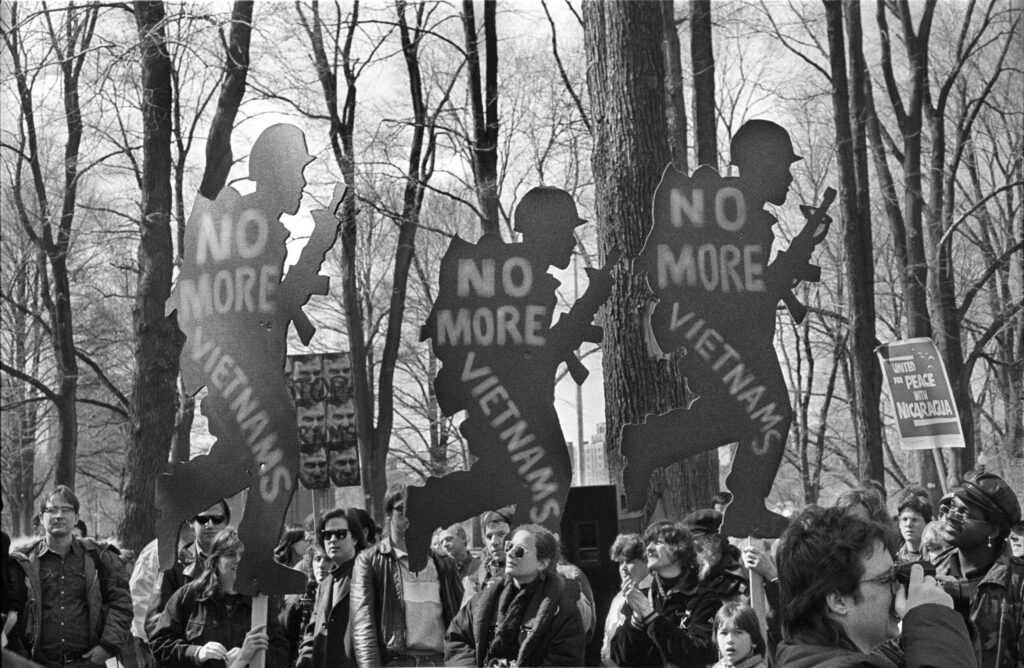
As I found out day by day in the Pentagon, that was our highest priority — preparing for a wider war.
Daniel Ellsberg
An Unwinnable War, Made Public
The Vietnam War lasted eleven years and, by most estimates, cost more than a million lives. Buried in the Pentagon Papers was proof that officials had understood the war couldn’t be won years before they admitted as much publicly — and had escalated it anyway.
The leak didn’t end the war by itself, but it turned public and political opinion sharply against it, and against the credibility of the administration running it. The White House’s attempt to discredit Ellsberg — including a break-in at his psychiatrist’s office — became part of the same pattern that later unraveled into the Watergate scandal and a president’s resignation.
The Man Who Chose Uncertainty
Here’s what makes Ellsberg’s story more than a footnote in American political history: he lived the very paradox he’d discovered a decade earlier. The government he worked for chose ambiguity — concealing what it knew, letting the public guess at a war it couldn’t win. Ellsberg chose the opposite. He gave up a known, comfortable outcome for a genuinely uncertain one, with no way to calculate whether it would end in prison, in disgrace, or in nothing changing at all. Unlike the ball in his own experiment, he couldn’t know the odds going in. He acted anyway, on the belief that the public deserved to.
That’s arguably the real lesson behind the Ellsberg Paradox, and why it’s still cited more than sixty years later: we’re not wired to treat “unknown odds” the same way we treat “bad odds” — we’ll often take a worse guaranteed outcome over a better uncertain one, simply because it’s known. Ellsberg spent his early career studying that instinct. Later, when it mattered most, he chose to fight it.
Unknown Unknowns
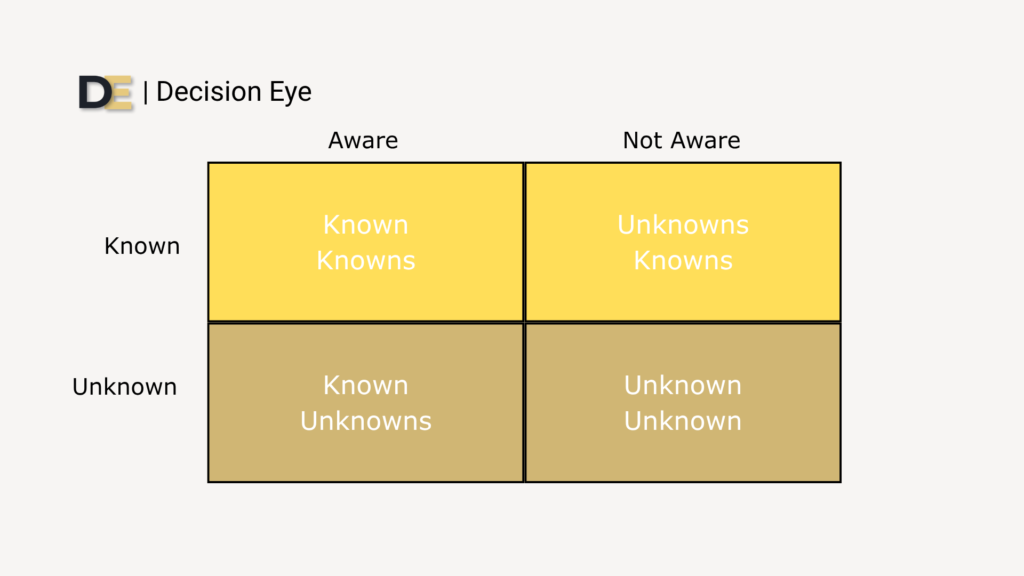
In The Decision Maker’s Playbook: 12 Mental Tactics for Thinking More Clearly, Navigating Uncertainty, and Making Smarter Choices, Simon Mueller and Julia Dhar pose a related question: “What if we haven’t formed a belief yet, possibly because we aren’t aware of the existence of something?” Their Awareness and Knowledge matrix offers a simple way to sort any subject into one of four quadrants. The bottom-right quadrant holds the real blind spots — the unknown unknowns, where we don’t even know that we don’t know. The Ellsberg Paradox lives two quadrants over from there: it shows that most people already treat known unknowns (ambiguity) as worse than known knowns (risk), long before a subject ever reaches true blind-spot territory.
Use Cases
The Ellsberg Paradox plays out constantly in business, through what’s known as ambiguity aversion: decision-makers consistently favor known risks over unknown ambiguity.
Use Case: Go-to-Market Decisions
A business expanding into an established market can calculate concrete historical failure rates, win rates, conversion rates, and other metrics. Expanding into an entirely new sector, by contrast, comes with no historical data at all. As a result, decision-makers often keep investing in saturated, traditional markets simply because the risk there is measurable. For more on how to make better go-to-market decisions, see our related case study, Go-to-Market Decision: A Pharmaceutical Industry Case.
Use Case: Supply Chain Management
Companies often stick with known suppliers even when a new one offers a 40% cost reduction. Procurement managers frequently pass up significant savings because they’d rather deal with the quantifiable defect rates of a familiar domestic supplier than the unquantifiable risks of a new foreign one. The new supplier may carry a genuinely better expected value, but because it also carries uncertainty, procurement managers choose the known option anyway — exactly what the paradox predicts.
Use Case: Consumer Behaviour
Consumers show the same bias. Buying from a known brand like Samsung, LG, or Apple is consistently valued more highly than buying from a lesser-known one, even when that’s not rational. Diligent research might turn up a less popular but well-established brand at a lower price, yet most consumers will still pay more for the name they already trust. It’s a textbook case of the Ellsberg Paradox at the checkout counter.
How to Start Overcoming Blind Spots
- Understand how your mind works. Our minds naturally look for evidence that confirms what we already believe. See Confirmation Bias: How Overconfidence Leads to Poor Decisions for more on this tendency.
- Spot the uncertainty. What exactly makes this option feel uncertain? Is there a workaround? Is it genuinely uncertain, or does it just feel that way? Could the uncertainty be removed?
- Argue the other side. Build the strongest possible case for the alternative view, and think through what it’s actually based on.
- Give yourself time to revisit it. Judgment made under time pressure can be distorted — coming back later lets you check whether your view still holds up.
The Ellsberg Paradox is a finding in decision theory, discovered by economist Daniel Ellsberg in 1961, showing that people prefer bets with known odds (risk) over bets with unknown odds (ambiguity).
Risk describes situations where the odds are known, like a coin flip. Uncertainty (or ambiguity) describes situations where the odds themselves are unknown.
Ambiguity aversion is the tendency to prefer options with known risks over options with unknown risks, even when the unknown option could be equally or more favourable.
Businesses often favour familiar suppliers, established markets, and known brands over better but less certain alternatives, even when the alternative has a higher expected value. This shows up in go-to-market strategy, supply chain sourcing, and consumer brand preference.
Known unknowns are things we’re aware we don’t know, like the odds in the Ellsberg Paradox’s second urn. Unknown unknowns are blind spots — things we don’t know and aren’t even aware we don’t know.
References
- Ellsberg, D. (1961). Risk, ambiguity, and the Savage axioms. The Quarterly Journal of Economics, 75(4), 643–669. https://doi.org/10.2307/1884324
- Ellsberg, D. (2002). Secrets: A memoir of Vietnam and the Pentagon papers. Viking.
- Mueller, S., & Dhar, J. (2021). The decision maker’s playbook: 12 mental tactics for thinking more clearly, navigating uncertainty, and making smarter choices. FT Publishing International.
- Peterson, M. (2017). An introduction to decision theory (2nd ed.). Cambridge University Press.
- The Editors of Encyclopaedia Britannica. (n.d.). Pentagon Papers. Encyclopedia Britannica. Retrieved September 15, 2026, from https://www.britannica.com/topic/Pentagon-Papers
- Jarecki, E., & Ehrlich, J. (Directors). (2009). The most dangerous man in America: Daniel Ellsberg and the Pentagon Papers [Film]. Kovno Communications.

Timucin Tasdemir, M.Sc.
Decisions aren’t found. They’re built.
I write about decision-making, cognitive biases, and decision architecture at Decision Eye. Most poor decisions come not from a lack of intelligence, but from a lack of structure.
Disclaimer: The views and opinions expressed in this article are solely my own and do not reflect the official policy or position of any past, present, or future employer or affiliated organisation. This content is intended for informational and educational purposes only and does not constitute professional advice.
Leave a Reply