Beyond a certain threshold, an overabundance of choices severely diminishes the quality of life.
Some Cognitive Biases and Errors can lead us to make the wrong decisions. They can guide us toward incorrect choices even in situations in our daily lives that we never fully realize. In this article, I will talk about an important cognitive error: the “Paradox of Choice.” I will focus on how we should think about this and how careful we need to be when making our decisions. Otherwise, we might find ourselves spending a significant amount of time without ever reaching a conclusion.
The Story
On one of my business trips, I had the opportunity to attend a global sales conference in the United States. When I entered the conference center, I took my place in the seats along with 3,000 other people. The main stage was impressive and inspiring. After the shows and profound performances by the entertainment team, the keynote speakers began taking the stage. They spoke about technology, how the world is changing, and how it will impact our lives. We were all deeply focused because the stage was highly engaging and the messages were directly relevant to us.

Later on, the person leading this transformation process stepped onto the stage, and behind him was a massive, giant screen displaying a statement. That statement was: “Less is more.” On that giant screen, the phrase “Less is more” created a complete paradox. However, the intended message was perfectly clear.
Throughout the speech, this speaker talked about simplifying processes, streamlining products, and reducing and easing choices for customers.
Simplicity is the ultimate sophistication
Leonardo Da Vinci
Less Is More in Practice
Over the next three years following the conference, I had the chance to personally witness how these processes translated into reality and how the company pursued a serious vision in this regard. Products were simplified, commercial options were reduced, the complexity right in front of the customer was removed, and customers were presented with only limited choices.
The result? While the company had been struggling with a cash flow crisis just a few years prior, three to four years later, it would reach 400% of its previous revenue.
Why Do Too Many Options Distract Us?
I am sure most of you reading this article shop at supermarkets. If you are doing your shopping at an average supermarket, it might take anywhere from 45 minutes to 1.5 hours, or even 2 hours. However, if you are entering what is referred to as a “superstore”—large supermarkets with an overwhelming number of options—your shopping time will easily exceed 2 hours, perhaps stretching to 3 or even 4 hours.

This is because in those massive supermarkets, you will face countless options, and you will have to spend time evaluating and thinking through those choices. We experience this many times in our modern lives as well. In fact, when the number of choices exceeds eight, we begin to struggle with decision-making.
Let me give you an example: Imagine you are walking through a supermarket and you need to buy a can of tomato paste. You walk over to the tomato paste aisle. There, you notice that alongside the brands you normally buy, dozens of alternative options have been placed. Every single one of them features beautiful labels and explanations, and let’s assume there are more than 20 different kinds. Do you know what the outcome will be? Total decision paralysis. The technical term for this is the “Paradox of Choice.”
In his book The Art of Thinking Clearly Rolf Dobelli mentioned this error. As he stated “Yes, abundance makes you giddy, but there is a limit. When it is exceeded, a surfeit of choices destroy quality of life.”
Reduce the options, increase the sales
To test this, various experiments have been conducted in supermarkets and different commercial businesses. Speaking from my own experience, I have witnessed just how successful this approach can be. When we reduced our options, our communication with customers improved, the value we offered them increased, and our conversion processes became much smoother. This ultimately helped drive revenues up by four to five times. A vast network of choices leads us to make weaker decisions.
More Choices, Better Partners?
We can illustrate this further with another example: Today, both men and women have far more choices when it comes to selecting a partner than their ancestors did a century ago. One hundred years ago, your ancestors rarely had the option to travel to different countries to find a spouse, get married there, or meet people from completely different cities. To do so, they had to risk or overcome illnesses, long journeys, and the inherent dangers of travel—such as bandits, attackers, diseases, accidents, and natural disasters.
Today, however, finding a partner is right at humanity’s fingertips. Through various dating apps, we can meet, connect, and potentially start relationships with people living in entirely different cities.
But what is the actual result? Despite this abundance of choices, shouldn’t humanity be making better decisions when choosing a partner? After all, our options have increased, and we now have the chance to make more accurate decisions from a larger pool. This should mean we are able to build higher-quality and more successful partnerships, right?
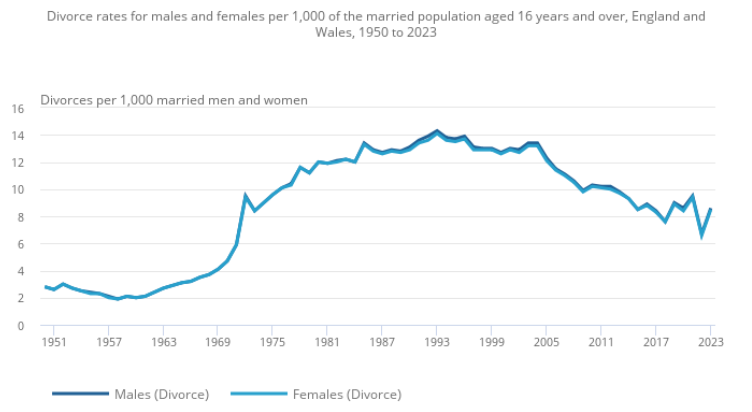
When we look at the statistics, we see that we are living in an era where divorce rates are higher than at any other point in history. According to The Office for National Statistics, divorces in the UK are much higher than before. We likely live much more comfortable and higher-quality lives than the nobility residing in French palaces, and we have far more options for finding a partner. Yet, despite this, divorce and separation rates are at record highs. More children than ever before are growing up in single-parent households.
It has been proven that possessing more options than necessary eventually degrades our decision criteria. It cognitively pushes a person to evaluate choices based on just a single factor. Studies show that when forced to choose from an overwhelming number of options, individuals looking for a partner tend to lean toward physical attractiveness rather than deeper qualities like character, virtues, or morals.
What is the Solution?
Limit your options. The grass isn’t always greener on the other side. Sometimes, making a decision by saying “I have enough options” is far better than reviewing 200 different choices while thinking “I can still find something better.”
List your criteria. If you are going to make a decision, list your criteria beforehand to avoid falling into this trap. But think them through rigorously. Afterward, stick to these criteria strictly.
Accept that there is no perfect decision. Realize that no matter how many options you have, there is no such thing as a perfect choice. Making a decision inherently means making a trade-off.
By staying firmly committed to the selection criteria you have set, try to find the right decision among the available choices. In my upcoming articles, I plan to share different methods and approaches regarding this topic.
However, if the choice you made is good enough, know how to be content with it and say, “This is good enough.” Yes, this even applies to choosing your life partner. Finding “good enough” means finding the optimum choice. And as engineers know well, reaching the optimum is one of the primary duties in the world of engineering.
Key Takeaways for Tomorrow
- The abundance of choices can lead us to an indecision stage. The technical term is the paradox of choice.
- It has been proven that possessing more options than necessary eventually degrades our decision criteria.
- The solution: Limit your options, List your criteria, and accept that there is no perfect decision.
- Remove complexity from your customer facing operations, to increase deal velocity you should simplify offerings.
References
- Dobelli, R. (2014). The art of thinking clearly. Sceptre.
- Office for National Statistics. (2024). Figure 3a: Divorce rates have declined since the 1990s, despite recent fluctuations [Graph]. Divorces in England and Wales.https://www.ons.gov.uk/

Timucin Tasdemir, M.Sc.
Decisions aren’t found. They’re built.
I write about decision-making, cognitive biases, and decision architecture at Decision Eye. Most poor decisions come not from a lack of intelligence, but from a lack of structure.
Disclaimer: The views and opinions expressed in this article are solely my own and do not reflect the official policy or position of any past, present, or future employer or affiliated organisation. This content is intended for informational and educational purposes only and does not constitute professional advice.
Leave a Reply