A decision is difficult only because the mind cannot weigh what it cannot see all at once.
Benjamin Franklin was, without a doubt, a singular historical figure. A wise man who excelled as an author, scientist, politician, and diplomat, Franklin’s diverse expertise provided him with remarkable mental clarity. Above all, his biography reveals a master-class skill in simplification—a trait that defined his legacy as a Founding Father. In this article, I will explain his decision-making approach, drawing directly from his personal letters and historical records.
The Story
In 2007, while studying mathematics in a small, historic city in Southwest Anatolia, I bought a copy of Milton Meltzer’s Benjamin Franklin: The New American. It immediately grabbed my attention. Despite my limited student budget, I recognized its value and invested a significant amount to own it.
Indeed, reading it was an engaging experience. At the time, I was seeking a practical framework for self-improvement, and Franklin’s method offered exactly that. Moreover, he approached the cultivation of habits with a discipline that was both rigorous and inspiring. As he famously noted:
“I conceived the bold and arduous project of arriving at moral perfection. I wished to live without committing any fault at any time; I would conquer all that either natural inclination, custom, or company might lead me into. As I knew, or thought I knew, what was right and wrong, I did not see why I might not always do the one and avoid the other. But I soon found I had undertaken a task of more difficulty than I had imagined.“
Benjamin Franklin
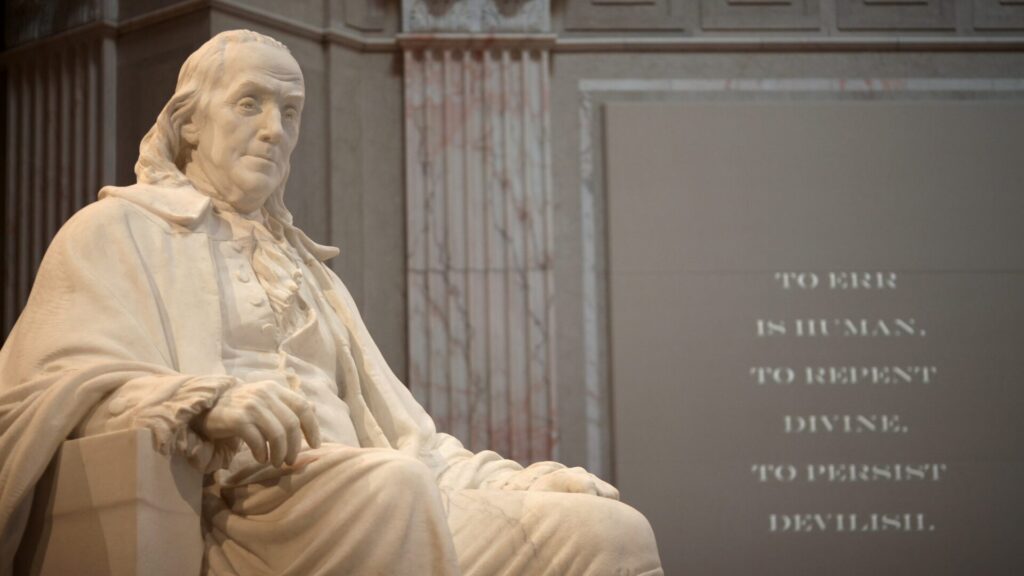
Franklin’s Virtues Notebook
To operationalize his perspective, Franklin developed a structured ‘Virtues Notebook.’ He identified twelve core principles to excel, each accompanied by a clear, actionable direction:
- Temperance: Eat not to dullness; drink not to elation.
- Silence: Speak only what may benefit others or yourself; avoid trifling conversation.
- Order: Let all your things have their places; let each part of your business have its time.
- Resolution: Resolve to perform what you ought; perform without fail what you resolve.
- Frugality: Make no expense but to do good to others or yourself; waste nothing.
- Industry: Lose no time; be always employed in something useful; cut off all unnecessary actions.
- Sincerity: Use no hurtful deceit; think innocently and justly; speak accordingly.
- Justice: Wrong none by doing injuries, or omitting the benefits of your duty.
- Moderation: Avoid extremes; forbear resenting injuries so much as you think they deserve.
- Cleanliness: Tolerate no uncleanness in body, clothes, or habitation.
- Tranquility: Be not disturbed at trifles, or at accidents common or unavoidable.
- Chastity: Rarely use venery but for health or offspring; never to dullness, weakness, or the injury of your own or another’s peace or reputation.
Later, Inspired by his method, I developed my own ‘Virtues Notebook,’ which proved instrumental in defining my personal and professional direction. For this clarity, I owe gratitude to Benjamin Franklin.
Beyond the method itself, this exercise reveals Franklin’s diligence. In fact, he was a clever and committed individual, focused on the relentless improvement of his own character and life.
A Letter to a Friend
Joseph Priestley asked his friend Benjamin Franklin about making decisions for two choices. In response, Ben Franklin replied with a letter dated 19 September 1772 from London. Also, you can find an online version of the letter in American Archives in the references. Here you can see Benjamin Franklin’s response to his friend:
Dear Sir,
In the Affair of so much Importance to you, wherein you ask my Advice, I cannot for want of sufficient Premises, advise you what to determine, but if you please I will tell you how.
When these difficult Cases occur, they are difficult chiefly because while we have them under Consideration all the Reasons pro and con are not present to the Mind at the same time; but sometimes one Set present themselves, and at other times another, the first being out of Sight. Hence the various Purposes or Inclinations that alternately prevail, and the Uncertainty that perplexes us.
The Method in Franklin’s Own Words
To get over this, my Way is, to divide half a Sheet of Paper by a Line into two Columns, writing over the one Pro, and over the other Con. Then during three or four Days Consideration I put down under the different Heads short Hints of the different Motives that at different Times occur to me for or against the Measure.
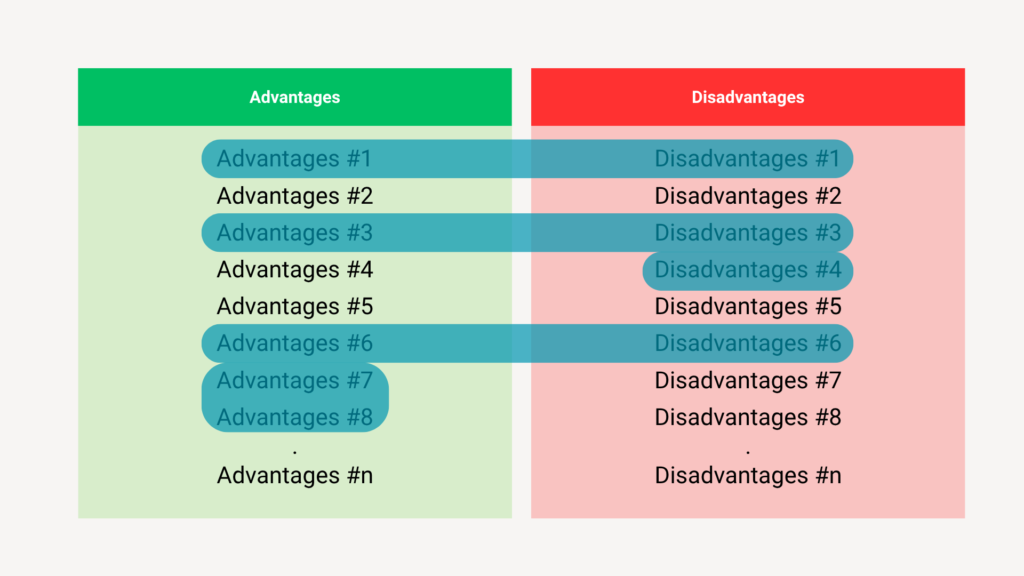
When I have thus got them all together in one View, I endeavour to estimate their respective Weights; and where I find two, one on each side, that seem equal, I strike them both out: If I find a Reason pro equal to some two Reasons con, I strike out the three. If I judge some two Reasons con equal to some three Reasons pro, I strike out the five; and thus proceeding I find at length where the Ballance lies; and if after a Day or two of farther Consideration nothing new that is of Importance occurs on either side, I come to a Determination accordingly.
And tho’ the Weight of Reasons cannot be taken with the Precision of Algebraic Quantities, yet when each is thus considered separately and comparatively, and the whole lies before me, I think I can judge better, and am less likely to make a rash Step; and in fact I have found great Advantage from this kind of Equation, in what may be called Moral or Prudential Algebra. Wishing sincerely that you may determine for the best, I am ever, my dear Friend,
Yours most affectionately
B Franklin
Franklin Approach
In his approach, Franklin outlined a systematic model for navigating complex choices—a method. In particular, his process follows a structured, multi-day framework:
- Acknowledge the Difficulty: He first admitted that making a decision in a complex case is difficult.
- The Visual Framework: Divide a page into two columns: one for Pro (advantages) and the other for Con (disadvantages).
- The Incubation Period: Reflect on the case for three to four days, recording every advantage and disadvantage that arises during this window.
- Weighting and Consolidation: After gathering all points, assign relative weights to each entry.
- The Elimination Process: Strike out an advantage and a disadvantage that carry equal weight.
- Remove two advantages that together equal one significant disadvantage.
- Continue this ‘subtraction’ (e.g., three advantages vs. two disadvantages) until the core priorities remain.
- The Final Decision: Continue the process until the remaining data points provide a clear, logical direction.
As Hammond, Keeney and Raiffa mentioned in their book, Smart Choices “Ben Franklin recommended a great way to simplify a complex problem.”
Reference
- Meltzer, M. (1988). Benjamin Franklin: The New American. Franklin Watts.
- Franklin, B. (1772, September 19). From Benjamin Franklin to Joseph Priestley. Founders Online, National Archives. https://founders.archives.gov/documents/Franklin/01-19-02-0200
- Hammond, J. S., Keeney, R. L., & Raiffa, H. (1999). Smart Choices: A Practical Guide to Making Better Decisions. Harvard Business Review Press.

Timucin Tasdemir, M.Sc.
Decisions aren’t found. They’re built.
I write about decision-making, cognitive biases, and decision architecture at Decision Eye. Most poor decisions come not from a lack of intelligence, but from a lack of structure.
Disclaimer: The views and opinions expressed in this article are solely my own and do not reflect the official policy or position of any past, present, or future employer or affiliated organisation. This content is intended for informational and educational purposes only and does not constitute professional advice.
Leave a Reply