Prioritization is, at its heart, an economic discipline. It is the art of managing our most limited resource: Time.
In today’s hyper-connected landscape the ability to prioritize is no longer just a productivity hack—it is a survival skill. We are making prioritization in our life however our brain naturally filters information through the subconscious. When the stakes are high, relying on intuition isn’t enough. Here are two frameworks that may help you along the way.
The Story
I remember sitting in a quiet classroom, framed by a peaceful view of a garden. While the swaying green leaves outside tried to pull my attention away, the lecturer’s voice anchored me back. He was a natural storyteller, and that day he was explaining the core of economics.
‘Economics,’ he said with absolute confidence, ‘is the social science that studies how to satisfy unlimited human needs with strictly limited resources.’ That definition led me to a profound shift in my perspective. As the class dove into an engaging debate about human nature and infinite demands, I realized that prioritization is, at its heart, an economic discipline. It is the art of managing resources – time, attention, and capital. From this lens, time is no longer just a sequence of minutes; it is our most valuable asset. And how we ‘spend’ it through prioritization determines our return.

Why Prioritization Matters?
Due to multitasking, from time to time I have tasks which unfinish and these unfinished tasks remind me of myself in a constant manner. I always found this quite odd because unfinished tasks seem to remind themselves better than completed ones.
In the early 20th century, psychologist Bluma Zeigarnik identified this pattern, now known as the Zeigarnik Effect. Our brains are hardwired to remember interrupted tasks more than completed ones. When we fail to prioritize, these ‘open loops’ create constant cognitive noise, draining our focus and accelerating decision fatigue—a critical concept that we will explore in future articles.
The First Method: The Eisenhower Matrix
34th. President of the USA, Dwight D. Eisenhower stated in one of his speeches:
“I have two kinds of problems: the urgent, and the important. The urgent are not important, and the important are never urgent.”
Dwight D. Eisenhower
The name was coined by Stephen Covey, the author of The 7 Habits of Highly Effective People who took inspiration from President Eisenhower. The matrix has four quadrants with two rows as important and not important, two columns as urgent and not urgent.
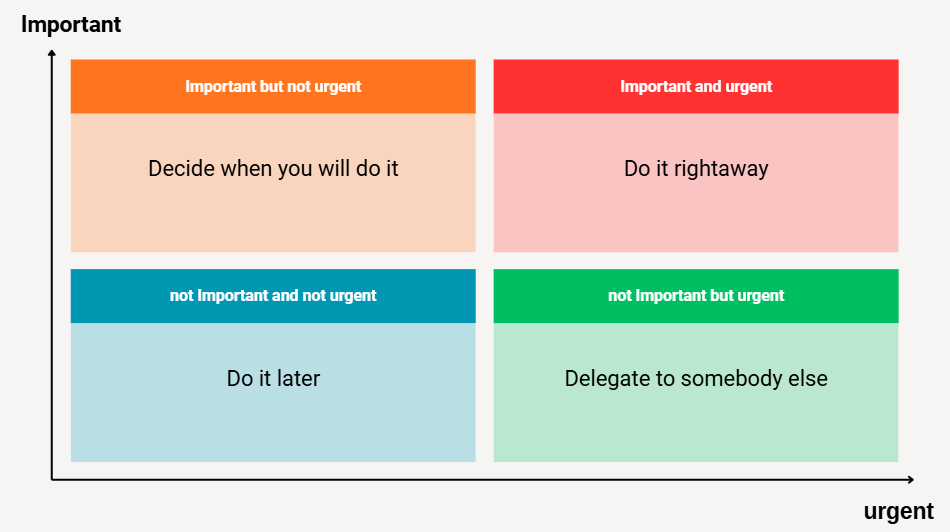
The First Quadrant: You should place tasks which are of high urgency and high importance here. These are the tasks you need to do right away.
The Second Quadrant: High Importance but low urgency. You can plan to complete these tasks in a convenient manner.
The Third Quadrant: High urgency but low importance. You can request help from your colleagues or delegate to somebody else.
The Fourth Quadrant: Low urgency and low importance. These tasks can wait.
The Second Method: Pareto Principle
The roots of strategic focus can be traced back to the Italian economist Vilfredo Pareto. While researching wealth distribution, Pareto observed a recurring, skewed pattern: 80% of the land and wealth was held by just 20% of the population. From this perspective, the following strategic conclusions emerge:
- 20% of tasks bring 80% of the value.
- 20% of work generates 80% of productivity.
- 20% of bills cost 80% of money.
- 20% of employees get 80% of income.
You may think about how to apply Pareto Principle to your day job. Here are the steps which I am using.
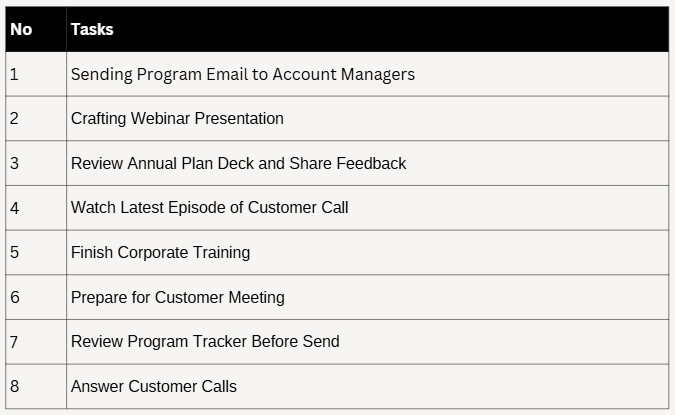
1# List all of the tasks in your mind
Include all of your tasks without filtering them. These could be urgent, important or could be done later. At this stage applying filters don’t help you but block to complete the list. You can see the example list for your reference as below. Add as many as you wish.
2# Sense Check
It is a quick and basic assessment to understand if these tasks make sense to complete. You should ask this question “Even if this task or a similar one needs to be completed, does it make sense in the real world as is and how it will be received?”
It is not only helpful for task management but leadership. As noted in Harvard Business Review, effective leadership requires sensemaking – ability to look at a complex situation and perform a sense check on which actions will actually drive results.
After a sense check if some tasks seem to you unnecessary and need adjustment then make necessary steps to adjust the tasks and clear your list. This will help you to save enormous execution energy when you make your hands dirty.
3# Sanity Check
Sanity Check, the cousin of the sense check, asks different questions. It tries to understand possibilities of the result. Human Brains are keen to include some unrealistic tasks to bucket but sanity checks can help you to detect and remove them. It isn’t a deep dive technical analysis; rather a “sniff test” to see if something is fundamentally broken.
4# Assign Priorities
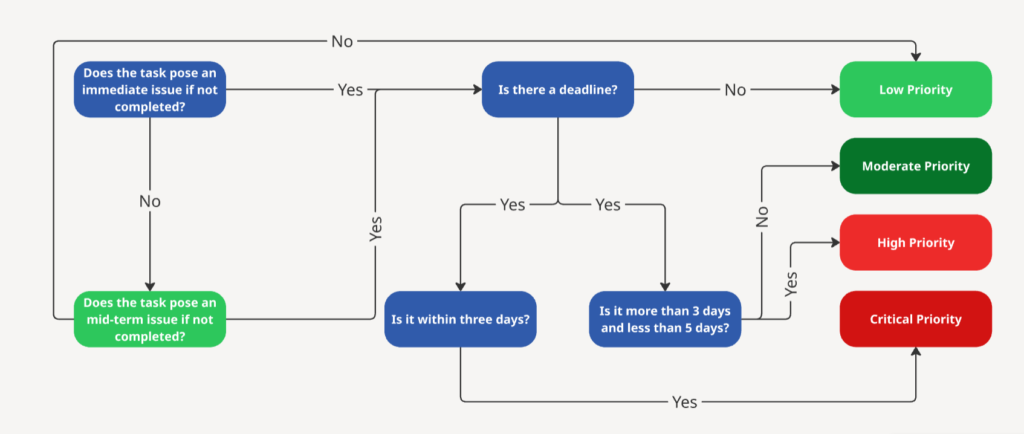
After completing checks you should assign weights regarding priorities. These should represent which tasks have more importance than others which will need your early execution to get most of the value. You may think about how to assign probabilities.
44th President of the USA, Barack Obama was using a rule to make decisions and priorities. This method is mentioned in Krogerus and Tschappeler’s The Decision Book Fifty models for strategic thinking. Obama established three Yes/No questions to understand priorities of the case and make the decision. It was about military but we can tweak it for a more peaceful purpose. You can see my Yes/No flow as diagram below:
5# Find Top %20
After placing tasks into buckets then you should list these priorities and then find the top %20 to focus on. Your list could look like this:
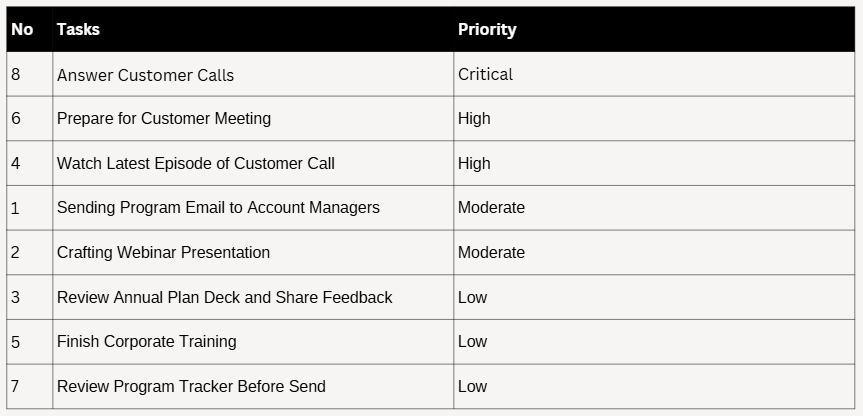
In our list, we have 8 tasks %20 of 8 is equal to 1.6 and if we round up 2. Therefore, we can focus on the top 2 tasks in our list. According to Pareto Principle, if we complete these two tasks, we will be getting %80 of the work. After finishing these tasks you can focus rest of them based on same principle to manage your time effectively.
The Practitioner’s Mindset
Mastering these frameworks is a matter of deliberate practice. While the initial steps may seem rigorous, they are designed to build a high-performance muscle over time. I encourage you to adapt these methods to your unique professional workflow. My goal is to provide the strategic view; the final execution and refinement belong to your professional discretion.
Takeaways for Tomorrow
- Manage the Cognitive Load: Use the Eisenhower Matrix to categorize your tasks.
- The Vital Few: Remember that in any complex system, 20% of your efforts will generate 80% of your strategic value. Your goal is to ruthlessly protect the time allocated to this ‘vital few.’
- The Sense Check: ‘Even if this task is completed perfectly, does it align with the real-world context, and how will it be perceived by stakeholders?’
- The Sanity Check: ‘Are we operating on major assumptions? If our core premise is proven incorrect, how dramatically does the outcome shift?’
References
- The Editors of Encyclopaedia Britannica. “Dwight D. Eisenhower.” Encyclopædia Britannica, https://www.britannica.com/biography/Dwight-D-Eisenhower.
- Snowden, D. J., & Boone, M. E. (2007, November). A Leader’s Framework for Decision Making. Harvard Business Review.
- The Editors of Encyclopaedia Britannica. (2024). Vilfredo Pareto. Encyclopædia Britannica. https://www.britannica.com/money/Vilfredo-Pareto
- Krogerus M. & Tschappeler R. (2017). The Decision Book Fifty Models for Strategic Thinking. Profile Books.
- Covey, S. R. (1989). The 7 Habits of Highly Effective People: Powerful Lessons in Personal Change. FranklinCovey Co.
Disclaimer: The views and opinions expressed in this article are solely my own and do not reflect the official policy or position of any past, present, or future employer or affiliated organisation. This content is intended for informational and educational purposes only and does not constitute professional advice.
Enjoyed this perspective? Please join my newsletter to stay connected about more insights for growth and decision theory.
Leave a Reply